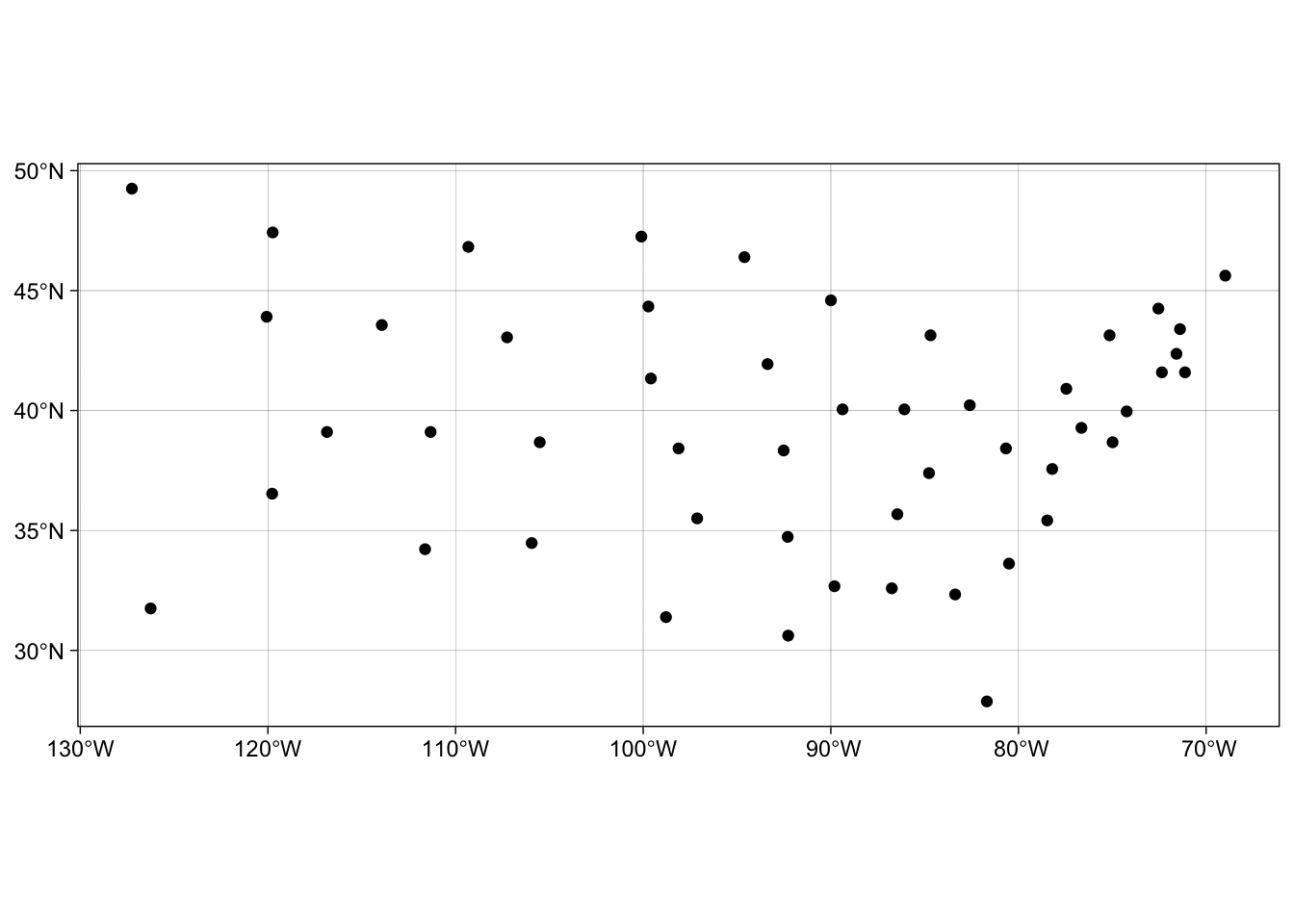
Simple feature collection with 50 features and 1 field
Geometry type: POINT
Dimension:     XY
Bounding box:  xmin: -127.25 ymin: 27.8744 xmax: -68.9801 ymax: 49.25
Geodetic CRS:  NAD83
First 10 features:
          name                 geometry
1      Alabama POINT (-86.7509 32.5901)
2       Alaska    POINT (-127.25 49.25)
3      Arizona POINT (-111.625 34.2192)
4     Arkansas POINT (-92.2992 34.7336)
5   California POINT (-119.773 36.5341)
6     Colorado POINT (-105.513 38.6777)
7  Connecticut POINT (-72.3573 41.5928)
8     Delaware POINT (-74.9841 38.6777)
9      Florida  POINT (-81.685 27.8744)
10     Georgia POINT (-83.3736 32.3329)
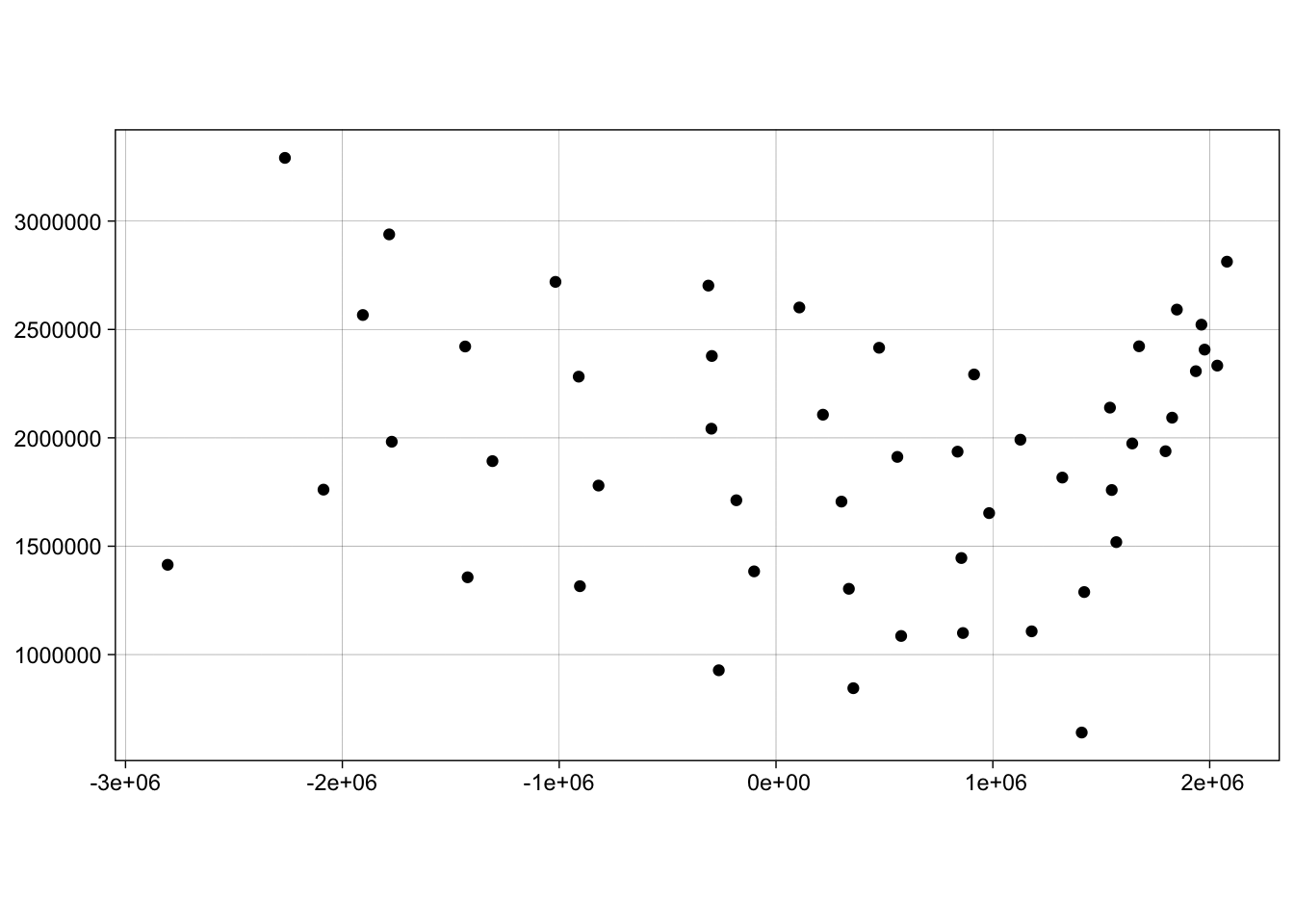
# Projected Coordinate System (PCS)# st_transforms converts from one reference system to another(df_sf_pcs =st_transform(df_sf_gcs, 5070))
Simple feature collection with 50 features and 1 field
Geometry type: POINT
Dimension:     XY
Bounding box:  xmin: -2805703 ymin: 640477 xmax: 2079664 ymax: 3291437
Projected CRS: NAD83 / Conus Albers
First 10 features:
          name                  geometry
1      Alabama  POINT (862043.5 1099545)
2       Alaska  POINT (-2264853 3291437)
3      Arizona  POINT (-1422260 1356663)
4     Arkansas  POINT (336061.5 1303543)
5   California  POINT (-2086972 1760961)
6     Colorado POINT (-818480.9 1779785)
7  Connecticut   POINT (1936213 2307450)
8     Delaware   POINT (1796466 1938236)
9      Florida    POINT (1409814 640477)
10     Georgia   POINT (1179012 1107322)
# Three most populous cities in the USA(big3 = cities |>select(city, population) |>slice_max(population, n =3))
Simple feature collection with 3 features and 2 fields
Geometry type: POINT
Dimension:     XY
Bounding box:  xmin: -2032603 ymin: 1468468 xmax: 1833394 ymax: 2178657
Projected CRS: NAD83 / Conus Albers
# A tibble: 3 × 3
  city        population           geometry
  <chr>            <dbl>        <POINT [m]>
1 New York      18832416  (1833394 2178657)
2 Los Angeles   11885717 (-2032603 1468468)
3 Chicago        8489066 (684628.3 2122698)
# Fort Collins(foco =filter(cities, city =="Fort Collins") |>select(city, population))
Simple feature collection with 1 feature and 2 fields
Geometry type: POINT
Dimension:     XY
Bounding box:  xmin: -760147.5 ymin: 1984620 xmax: -760147.5 ymax: 1984620
Projected CRS: NAD83 / Conus Albers
# A tibble: 1 × 3
  city         population            geometry
  <chr>             <dbl>         <POINT [m]>
1 Fort Collins     339256 (-760147.5 1984620)
# Distance from foco to population centersst_distance(big3, foco)
It is returned as a matrix, even though foco only had one row
This second point highlights a useful feature of st_distance, namley, its ability to return distance matrices between all combinations of features in x and y.
units review
st_crs(big3)$units
[1] "m"
Units can be converted using units::set_units. For example, ‘m’ can be converted to ‘km’.
If needed, drop units with units::drop_units() before numeric operations.
Geometry review
st_combine, st_union, and st_cast are commonly used together to build line boundaries for distance calculations. Use st_union() to dissolve internal boundaries for an outer border and st_combine() to preserve internal state lines.
# Example: cast to MULTILINESTRING for border distance calculations
# line_border = st_cast(st_union(states), "MULTILINESTRING")
Question 3:
Examples of gghighlight and ggrepel usage are included below; use stat = "sf_coordinates" when labeling sf points.